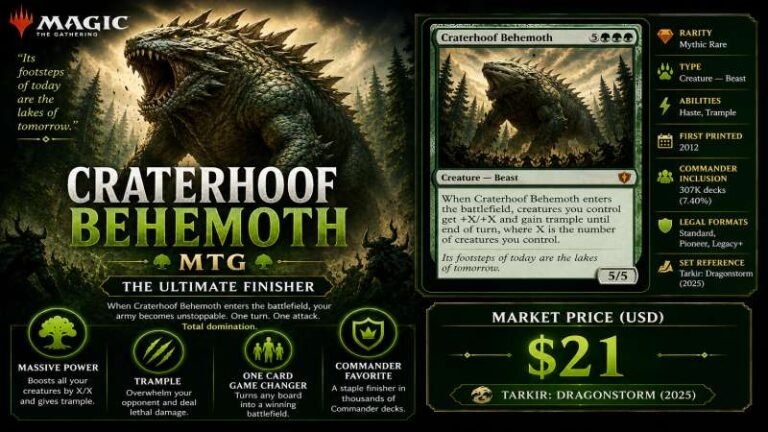
Craterhoof Behemoth: The Complete MTG Guide to the Ultimate Green Finisher
Few creatures in Magic: The Gathering carry the same reputation as Craterhoof Behemoth. Slam it onto a wide board and the game is usually over before your opponent gets another turn to respond. This guide covers everything worth knowing about craterhoof behemoth mtg: how the card actually works, its printings and price history, the best decks to run it in, its White counterpart, and the closest alternatives if you’re building around a similar effect in a different color.
What Is Craterhoof Behemoth?
Card Details and Core Ability
Craterhoof is a mythic rare Beast creature costing 5GGG, with 5 power and 5 toughness, originally illustrated by Chris Rahn and first printed in Avacyn Restored. It has haste, and when it enters the battlefield, every creature you control gains trample and gets +X/+X until end of turn, where X equals the total number of creatures you control at that moment. That single ability is enough to turn a board of small tokens into a lethal, trampling army in an instant, which is exactly why the card has become a Commander staple since its release.
Why the Timing of the Trigger Matters
A key ruling worth understanding is that X is calculated only once, as Craterhoof Behemoth’s own triggered ability resolves, and it only affects creatures you control at that exact moment. Any creatures you gain control of afterward that same turn won’t receive the trample or the +X/+X boost, which matters a lot for sequencing decisions in a turn where you’re trying to maximize the kill. Getting your full board of creatures out before Craterhoof resolves, rather than after, is essential to getting the most value out of the card.
Why Craterhoof Behemoth Is an EDH Icon
The Ultimate Go-Wide Payoff
Mtg craterhoof behemoth has earned its reputation specifically in Commander, where go-wide strategies built around tokens, Elves, and creature swarms are extremely common. A board of a dozen small creatures might look unthreatening on its own, but Craterhoof turns every single one of them into a massive trampling attacker in a single instant, often closing out the game the same turn it’s cast thanks to its built-in haste. Few single cards in the format generate that much immediate, game-ending value from one card slot.
A Card That Demands Answers
Because Craterhoof so reliably ends games on the spot, experienced Commander players treat it as a top-priority removal or counterspell target the moment it’s cast, if they have any interaction available at all. That reputation alone shapes how entire games play out, with opponents holding up removal specifically in anticipation of a Craterhoof-style finisher, even in decks that aren’t running the card themselves. Few creatures earn that level of respect purely from their name being announced at the table.
Printings, Secret Lair, and the Tarkir Return
From Avacyn Restored to Commander Staple
Craterhoof behemoth mtg has seen numerous reprints since its 2012 debut in Avacyn Restored, including Modern Masters 2017, Jumpstart, Commander Masters, and Innistrad Remastered. The card also appeared in a craterhoof behemoth secret lair drop, giving collectors an alternate-art version outside the normal set rotation, a common move for Wizards when a card has enough standalone popularity to justify a special printing on its own.
Its Surprise Return in Tarkir: Dragonstorm
More recently, Craterhoof Behemoth made a notable return to Standard-legal sets through Tarkir: Dragonstorm, complete with new art depicting the creature in a more elephant-like design. That reprint reignited interest in Green token and Elf strategies at the competitive level, since having Craterhoof legal in Standard again opened up deckbuilding possibilities that hadn’t existed since its initial run rotated out years earlier.
Craterhoof Behemoth Price History
A Card That’s Held Its Value for Years
Pricing for craterhoof has remained relatively strong for over a decade, generally sitting in the $20 to $40 range depending on printing and market conditions, with the original Avacyn Restored version typically commanding a premium over later reprints. As of recent tracking, the card sits around $21 to $22, reflecting steady, sustained demand rather than a speculative spike, which is fairly unusual for a card this old still holding meaningful value.
Why Reprints Haven’t Crashed the Price
Despite multiple reprints over the years, Craterhoof’s price has proven more resilient than a lot of similarly reprinted cards, largely because Commander demand keeps pace with new supply entering the market. Every new Commander-focused product or Secret Lair drop tends to briefly dip the price before it recovers, a pattern that reflects just how consistently the card gets included in green-based Commander decks built around tokens or wide boards.
Combos and Synergies Worth Knowing
The Classic Elf and Token Package
The most common and reliable way to use mtg craterhoof is simply building a deck around generating as many creatures as possible before casting it, whether through Elf tribal synergies, token-generating enchantments, or ramp strategies that flood the board early and often. Classic green Elf decks, going back to competitive Legacy and Modern lists over the years, have used Craterhoof as their primary finisher for a long time, since Elf decks naturally produce enormous boards of small creatures that Craterhoof turns into a lethal, trampling attack in a single turn.
A True Infinite Combo Line
For players chasing a guaranteed win, there’s also a documented combo involving Momir Vig on the battlefield alongside Maelstrom Wanderer in hand or the command zone, combined with at least seven lands and enough creatures left in your library, producing at least 137 trample damage in a single line of play. While this specific combo requires a fairly narrow set of pieces to come together in the right order, it illustrates just how much raw damage output Craterhoof-based strategies are capable of generating when the right pieces line up on the same turn.
White Craterhoof: Moonshaker Cavalry
Wizards’ Own White Answer to Craterhoof
When Wilds of Eldraine previewed Moonshaker Cavalry in 2023, Wizards of the Coast’s own head designer directly called it “the white craterhoof Behemoth,” and the comparison holds up. Moonshaker Cavalry costs 5WWW compared to Craterhoof’s 5GGG, and it gives your whole board +X/+X where X is your creature count, mirroring the core mechanic almost exactly, just built for White’s go-wide strategies instead of Green’s.
How It Actually Differs From the Original
The key difference between white craterhoof mtg builds and the original is the secondary keyword granted: Moonshaker Cavalry gives flying instead of trample, and it comes without haste. On most boards, flying tends to be the stronger evasion option than trample, since it’s harder for an opponent to block at all, though trample still gets through partial damage even against a full wall of blockers, which matters in specific board states. For White Weenie or token-heavy Selesnya decks, Moonshaker Cavalry has become the natural go-to finisher in the same design space Craterhoof occupies for Green.
Cards Like Craterhoof Behemoth
Other Anthem-Style Finishers
Beyond Moonshaker Cavalry, several other cards like craterhoof behemoth exist across different colors and formats, generally following the same design template: a big buff to your entire board tied to your creature count, often paired with evasion. Overrun and Beastmaster Ascension both scratch a similar itch for mono-Green decks without requiring a creature slot, while Triumph of the Hordes adds a poison-counter twist to the same overall strategy for players in more competitive formats.
Choosing the Right Finisher for Your Deck
Deciding between Craterhoof and its various alternatives usually comes down to color identity and whether you want the effect on a creature body or a cheaper noncreature spell that’s harder to answer with creature-specific removal. A deck that’s already creature-light might prefer an enchantment-based anthem effect, while a deck built to consistently flood the board benefits more from Craterhoof’s haste and immediate, game-ending swing the turn it resolves.
Building the Ideal Craterhoof Behemoth Deck
Ramp and Creature Density Come First
Any deck built to maximize craterhoof mtg needs two things above everything else: reliable mana ramp to hit seven mana consistently, and a critical mass of cheap creatures or token generators to make the eventual Craterhoof trigger as devastating as possible. Green’s toolbox is unusually well suited for this, offering mana dorks like Llanowar Elves and Elvish Mystic alongside ramp spells like Rampant Growth, letting a deck reach Craterhoof’s casting cost a turn or two ahead of a typical curve.
Protecting the Payoff Once It’s Cast
Because so much of a Craterhoof deck’s plan hinges on this single card resolving and sticking around long enough to attack, running protective spells like Heroic Intervention or counterspell backup becomes a real consideration in more competitive metas. Losing Craterhoof to a well-timed removal spell right as it enters can set a deck back significantly, so many competitive lists build in at least some insurance to guarantee the payoff actually connects once all the setup work is complete.
Craterhoof Behemoth in Constructed Formats
A Modern and Legacy Elf Tribal Staple
Beyond Commander, craterhoof behemoth has a long history as the finishing move in Elf tribal decks across Modern and Legacy, formats where the strategy revolves around flooding the board with mana-producing Elves before dumping most of your hand and swinging for lethal in a single turn. These decks are famous for going from an apparently harmless board state to a lethal attack out of nowhere, catching opponents off guard who weren’t tracking exactly how much damage a fully loaded board could produce.
Standard’s Renewed Interest After Tarkir: Dragonstorm
With its return to Standard through Tarkir: Dragonstorm, deckbuilders have started experimenting with Green-White token strategies that pair Craterhoof’s raw power with White’s efficient token generators, aiming to recreate a version of the classic go-wide finish within a competitive, rotating format. Early results suggest the card is just as capable of ending games quickly in Standard as it has been in eternal formats and Commander for over a decade.
Common Mistakes to Avoid With Craterhoof
Casting It Too Early
One of the most common mistakes newer players make with mtg craterhoof behemoth is casting it before their board is actually wide enough to matter. Firing off Craterhoof with only three or four creatures in play rarely ends a game outright, and it telegraphs your combat plan to the table while burning your best card for a fraction of its potential value. Patience, waiting an extra turn or two to develop a wider board first, usually produces a far more decisive result.
Ignoring Board Wipes and Removal
The other frequent mistake is not accounting for sweepers or spot removal that could wipe out your board or the Craterhoof itself before you get to attack. Holding protective spells, or simply being aware of what removal an opponent has shown throughout the game, helps avoid the frustrating scenario of building a perfect board state only to watch it evaporate to a well-timed board wipe the turn before you were planning to go for the win.
Collecting Craterhoof Behemoth: Which Printing to Get
Original Art vs. Alternate Printings
For collectors specifically hunting the original craterhoof behemoth artwork by Chris Rahn, the Avacyn Restored printing remains the most sought-after version, typically carrying a price premium over later reprints purely on nostalgia and original-art demand. Modern Masters 2017 and Commander Masters both offer more budget-friendly alternatives for players who want the card functionally without paying extra for the original printing, while still holding up fine in a competitive or casual deck.
Secret Lair and Foil Options for Showcase Decks
The craterhoof behemoth secret lair printing tends to appeal most to players building showcase or foil-focused Commander decks, offering alternate art that stands out visually at the table. The newer Tarkir: Dragonstorm printing, despite some fan debate over its elephant-like redesign, has also become popular simply for being the most recent and widely available version, making it an easy pickup for players just now getting into the card for a Standard or budget Commander build.
Why Craterhoof Behemoth Endures as a Design
Simple Text, Enormous Impact
Part of what makes craterhoof such an enduring design is how much impact it packs into a relatively simple block of rules text. There’s no complicated stack interaction to track, no convoluted trigger conditions, just a single, clean effect that scales directly with how well you’ve built and played your deck up to that point. That simplicity is a big part of why the card remains approachable for newer players while still being a genuine build-around for experienced deckbuilders chasing the most explosive possible turn.
A Template Wizards Keeps Returning To
The fact that Wizards of the Coast has explicitly designed newer cards like Moonshaker Cavalry to fill the same role in other colors is itself a testament to how well the original design has aged. Rather than treating Craterhoof as a one-off green specialty, the company has leaned into it as a template worth adapting, which speaks to just how well-received and mechanically satisfying the original effect has proven to be across more than a decade of play.
Final Thoughts
More than a decade after its debut, Craterhoof Behemoth remains one of the most respected finishers in Magic, a card that single-handedly turns a wide board into a lethal attack the instant it resolves. Whether you’re building around the original craterhoof mtg in a token-heavy green deck, picking up its White counterpart in Moonshaker Cavalry, or exploring other cards like Craterhoof Behemoth for a different color identity, the design remains one of the most satisfying, game-defining effects the format has to offer, and it’s unlikely to lose that reputation anytime soon.
Frequently Asked Questions
What does Craterhoof Behemoth actually do?
It has haste, and when it enters the battlefield, all creatures you control gain trample and get +X/+X until end of turn, where X is your total creature count.
How much does Craterhoof Behemoth cost?
Prices generally range from about $20 to $40 depending on the specific printing, with the card currently sitting around $21 to $22.
What is the White Craterhoof Behemoth?
Moonshaker Cavalry from Wilds of Eldraine, officially described by Wizards of the Coast as a White version of the same effect, granting flying instead of trample.
Is Craterhoof Behemoth good in Commander?
Yes, it’s considered one of the best go-wide finishers in the format, commonly played in Elf, token, and creature-heavy green Commander decks.
What sets has Craterhoof Behemoth been printed in?
It’s appeared in Avacyn Restored, Modern Masters 2017, Jumpstart, Commander Masters, Innistrad Remastered, a Secret Lair drop, and Tarkir: Dragonstorm.
What are the best cards like Craterhoof Behemoth?
Moonshaker Cavalry, Overrun, Beastmaster Ascension, and Triumph of the Hordes all offer similar go-wide, board-buffing effects in different colors or formats.
Can Craterhoof Behemoth be countered or removed before it triggers?
Yes, since the trigger happens on entering the battlefield, any removal or counterspell that stops the creature from resolving or surviving prevents the effect entirely.